This article is part of a series on tactical medicine and gear placement
Overarching Principles, TLDR:
How many Tourniquets Should I Carry?
Follow the principle of one is none, two is one, three is two. One TQ is never enough. Why? You have two legs and two arms (even if you’re already missing one of those, the arteries and veins in your stump can still bleed). Some bleeds require more than one TQ to effectively stop the bleed. According to A study conducted a Role 2 Field Hospital here in Ukraine:
“Assistance was provided to 69 wounded or injured, including 5 civilians. In all, 102 tourniquets were applied on 95 extremities. Tourniquets were applied on all 95 (100%) extremities including 21 (22.1%) upper extremities and 74 (77.9%) lower extremities. In 5 cases, tourniquets were applied on 3 extremities, in 16 cases on 2 extremities, and in 48 cases on 1 extremity”.
The key takeaway from this is that in 21 of 69 cases, the patient needed more than one TQ.
Type of TQs
As a bottom line, don’t buy fake or cheap tourniquets. The Committee on Tactical Combat Casualty Care has an approved list of TQs which you can see at this link. When in doubt, go with the North American Rescue Combat Application Tourniquet (CAT), that is the model we will be referring to throughout this article. Check out our friend Rima’s deep dive article on the dangers of cheap/fake/knockoff/unapproved/bad TQs here.
Staging
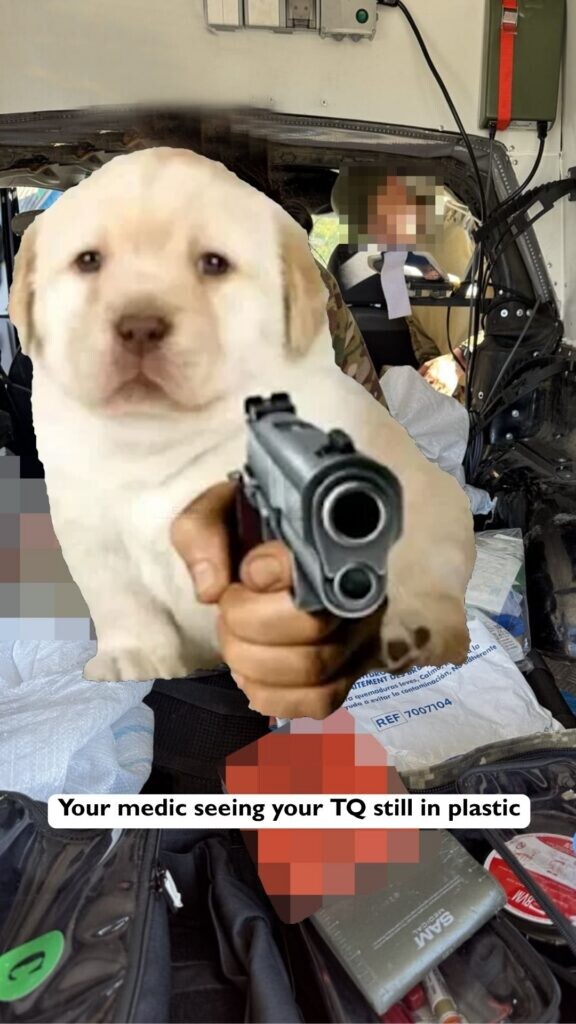
Properly stage your TQ. What does this mean? Take off the shrink wrap and make sure the velcro time tab isn’t placed over the windlass clip. If you’re in the situation where you’re applying a TQ, you’re probably under some significant stress. Having to fiddle with the velcro tab and remove the factory plastic takes precious time and will take longer than you think under stress. It takes 3 minutes or less to bleed out from a massive hemorrhage, every second counts— staging matters.
An added bonus to taking your TQ out of its factory plastic is it allows you to deploy, examine and repack it. Knowing your equipment and being familiar with how it works is key to being able to use it properly under stress. There are a couple different ways you can fold up your TQ
Placement
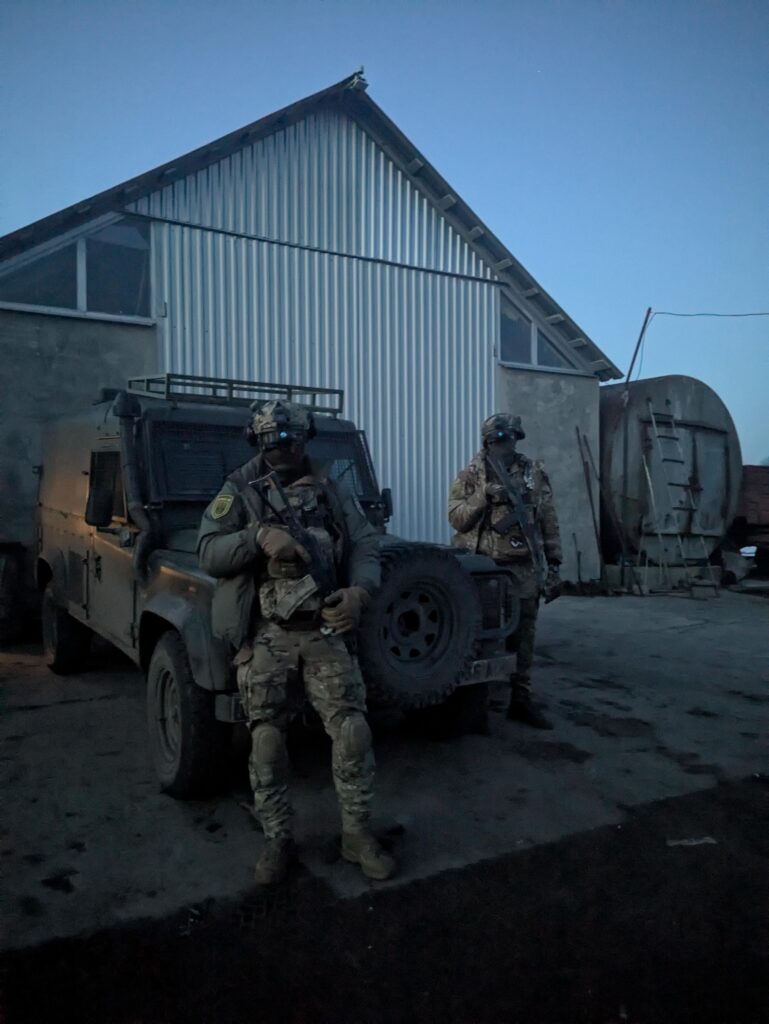
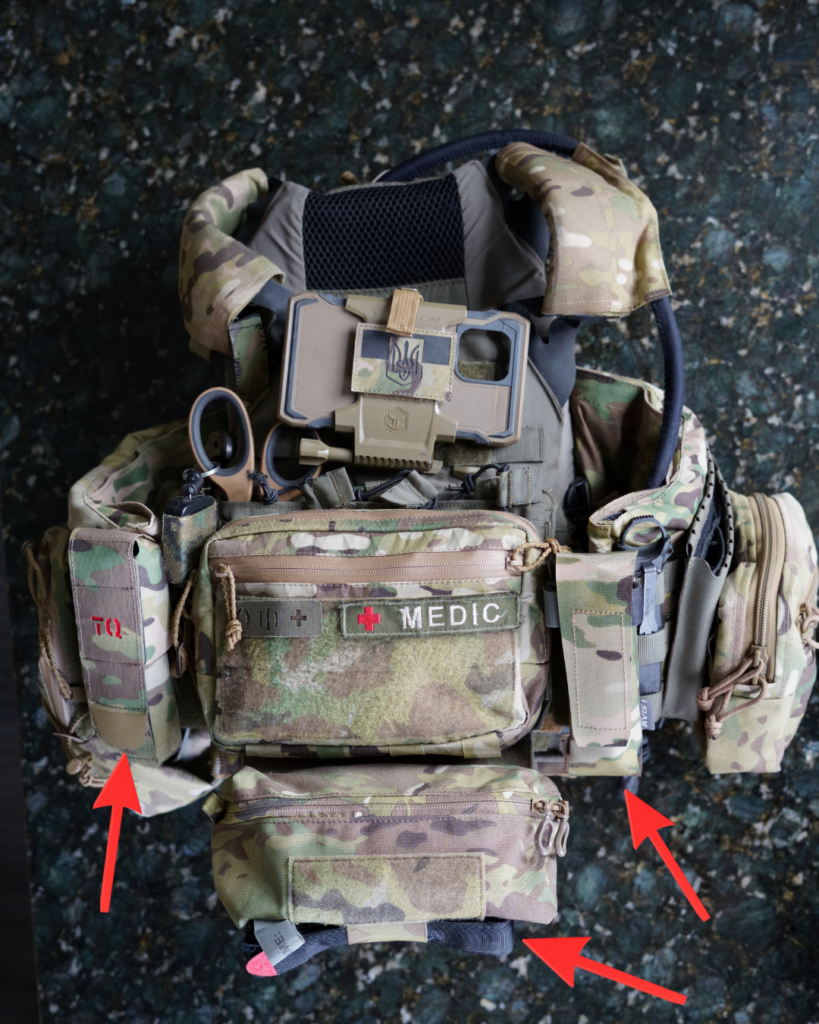
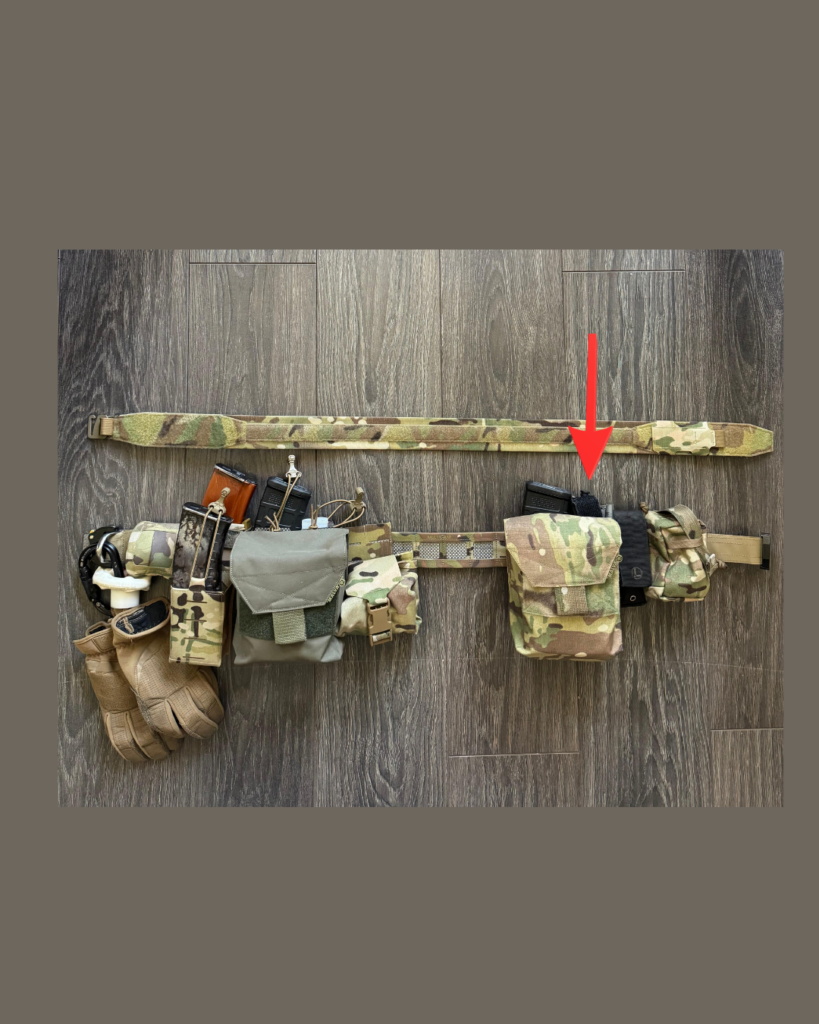
The main thing to remember: make sure you can easily reach and deploy all your TQs. One should be in easy reach of each hand in case you lose function of either one of your hands. We don’t recommend storing TQs in your IFAK pouch, place them in TQ holsters on your plate carrier or belt, shock cord them to your dangler or cummerbund— there are lots of options here. Here’s how I currently have my TQs setup on my kit:
Where not to store your TQs
Don’t store TQs in a shirt or trouser pocket. I know, the high speed community is going to take issue with this, but a common issue experienced both in training and in real world scenarios, is forgetting to empty the pockets before applying a TQ. Beyond just precious time and blood being lost while a responder searches and empties the pockets of a casualty before applying a TQ, a TQ applied over top of a stuffed pocket is deadly. Why does emptying the pockets matter? A TQ won’t be able to get equal pressure to successfully occlude the vessels in the wounded limb and blood will continue to flow from the wound. Your priority is to stop all sources of massive bleeding, and failing to apply an effective TQ could result in a patient bleeding out while you continue an assessment.
Like we stated above, we don’t recommend storing a TQ in your IFAK for tactical setups. Why? TQs need to be as easy to access as possible. If the TQ is in your IFAK, you first have to deploy your IFAK, get that opened up and then you can finally access your TQ; all while you’ve been bleeding heavily for that 10-30 seconds it took you to get to your TQ. Some IFAK pouches have an elastic sleeve or shock cord for storing TQ on the outside of the pouch which is a good option. As a bonus you gain space in the IFAK pouch for more hemostatic gauze by not storing a TQ in there. For everyday carry or a vehicle med bag it’s fine to store the TQ inside an IFAK pouch, but we still prefer having the TQ in a quick deploy position outside the IFAK.
From the team
I keep one TQ on each side of the placard on the front of my plate carrier, one shock-corded to my dangler and one in a pouch on my battle belt. The dangler and placard placement is ideal for me because they are easily reachable by both hands. The belt TQ is also a good placement when prone ie. I can still reach it when I’m lying on my stomach. As a medic, I also keep several TQs stashed elsewhere on my kit for use on patients. — Andrew
Tactical Medicine Considerations from Ukraine
Reassess, reassess, reassess. Train and study what injuries indicate applying a TQ. According to one study from Ukraine, TQ applications were inappropriate in 24.6% of recorded cases. Many of these cases resulted in totally avoidable amputations. This is why training and understanding when it is appropriate to apply a TQ and also how to replace and convert TQs is paramount: If you can save some or all of a patient’s limb, you should. Always strive to improve the outcome for your patient. Time to evac in Ukraine is almost always outside the 2-6 hour conversion time frame (usually more than a day), so waiting for a higher level of care to convert a TQ isn’t an option, you need to know when a TQ conversion is indicated and how to do it.
We’re of the opinion that it’s better to be safe than sorry when it comes to TQ application, if it’s dark and you’re under fire, it can be difficult to thoroughly assess a patient. But if you suspect massive hemorrhage, apply that TQ high and tight and then reassess ASAP and convert or replace the TQ if possible/not contraindicated.
From the TCCC overlords:
Limb tourniquets and junctional tourniquets should be converted to hemostatic or pressure dressings as soon as possible if three criteria are met: the casualty is not in shock; it is possible to monitor the wound closely for bleeding; and the tourniquet is not being used to control bleeding from an amputated extremity. Every effort should be made to convert tourniquets in less than 2 hours if bleeding can be controlled with other means. Do not remove a tourniquet that has been in place more than 6 hours unless close monitoring and lab capability are available.
NOTE: TCCC ASM/CLS trained personnel, should not attempt tourniquet conversion beyond 2 hours post-application unless directed by TCCC CMC/CPP personnel or other advanced medical personnel. In the absence of medical oversight, maintain the tourniquet in place and continue monitoring until the casualty reaches a higher level of care.
Citations
Stevens, Rom & Baker, Michael & Zubach, Ostap & Samotowka, Michael. (2024). Misuse of Tourniquets in Ukraine may be Costing More Lives and Limbs Than They Save. Military Medicine. 189. 10.1093/milmed/usad503.
Committee on Tactical Combat Casualty Care. (2026, May 1). Tactical Combat Casualty Care (TCCC) guidelines. Joint Trauma System, Defense Health Agency. https://tccc.org.ua/files/downloads/clinical-guidelines-2026-en.pdf
Yatsun, V. (2024). Application of hemostatic tourniquet on wounded extremities in modern “trench” warfare: The view of a vascular surgeon. Military Medicine, 189(1-2), 332–336. https://doi.org/10.1093/milmed/usac208
Related Products
-
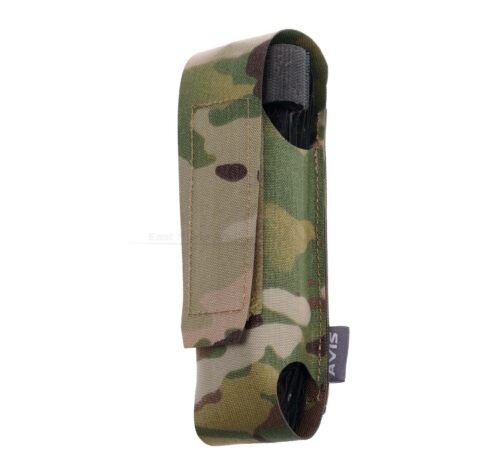
 Avis Gear Tourniquet Pouch500,00 ₴
 -
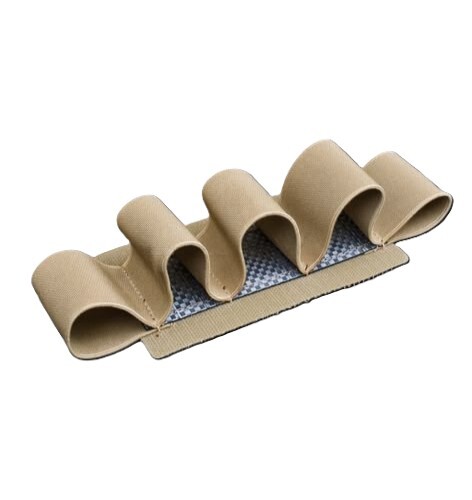
Malva Ammunition IFAK Organizer580,00 ₴
-
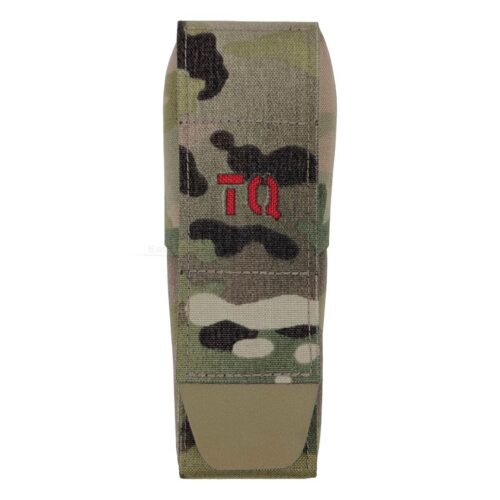
Rhizome Systems Tourniquet Pouch V2998,00 ₴