How ordinary people can avoid becoming weapons in an information war
The information battlefield:
//You are already part of the battlefield
Anything you see and share online is part of the information battlefield, intended or otherwise. How you behave in this space matters. Responsible digital citizenship is an essential layer of public defence.
When an adversary cannot easily breach the front line, they can attempt to break the society behind it. Fear, urgency, uncertainty and the desire to protect loved ones are powerful tools. They can turn well-meaning civilians into additional pieces of an information operation without those people ever intending to help the enemy.
//You don’t need to be a propagandist to become useful to one.
In this article, we will look at what that actually looks like in practice:
- The “Useful Idiot”: How well-meaning citizens can become amplifiers without realising it.
- Russian PSYOPs: What is the goal, and what does it actually look like on the ground?
- Lessons learned: what went wrong and what should we do differently
- Firsthand Account: An interview on the opening days of the full-scale invasion.
- Information Containment: Practical rules for digital discipline and OPSEC.
Contents
How well-meaning people end up helping the enemy.
“Useful idiot” is a term that gets thrown around a lot online. I don’t particularly like the phrase because it undermines who they actually are. Most people who spread disinformation aren’t propagandists. They’re people who think they’re helping.
They get influenced through social media, often failing to see that the platform itself has become an active battlefield. They latch onto foreign propaganda without understanding the end goals behind it.
We can all end up becoming a useful idiot if we aren’t careful. Nobody ever thinks of themselves as one, yet most of us have likely fallen into that trap at some point in our lives.
That is the uncomfortable part. The person sharing the rumour usually isn’t trying to help an adversary. They are trying to help a friend, protect their family, or make sense of something frightening.
//Intent doesn’t remove consequence.
PSYOPs
To understand psychological operations, we first have to look past the idea that their main goal is always to convince you of a complex political lie. Propaganda certainly exists, but during an active crisis the tactical goal can be much simpler: manufacture uncertainty, create internal chaos, overload local systems and make ordinary people react to incomplete information as if it were certain.
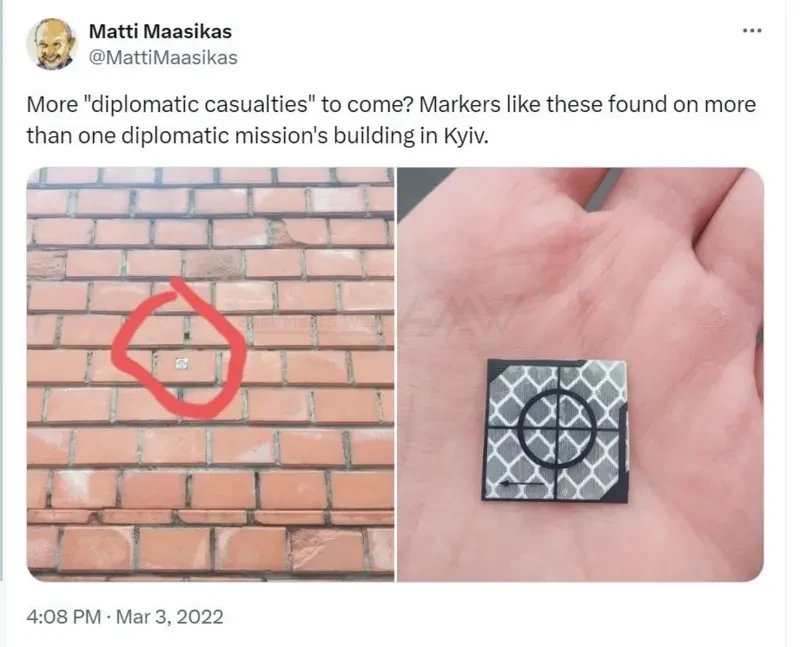
One example that comes to mind is Ukraine in 2022. During the initial days of the full-scale invasion, people started noticing something suspicious: crosshairs, arrows and other apparently tactical markings painted on streets, buildings and other surfaces. People noticed them, rumours spread quickly, and even local authorities urged citizens to report suspicious markings. An Estonian diplomat posted about suspicious stickers found on their building, and the national police also shared images.
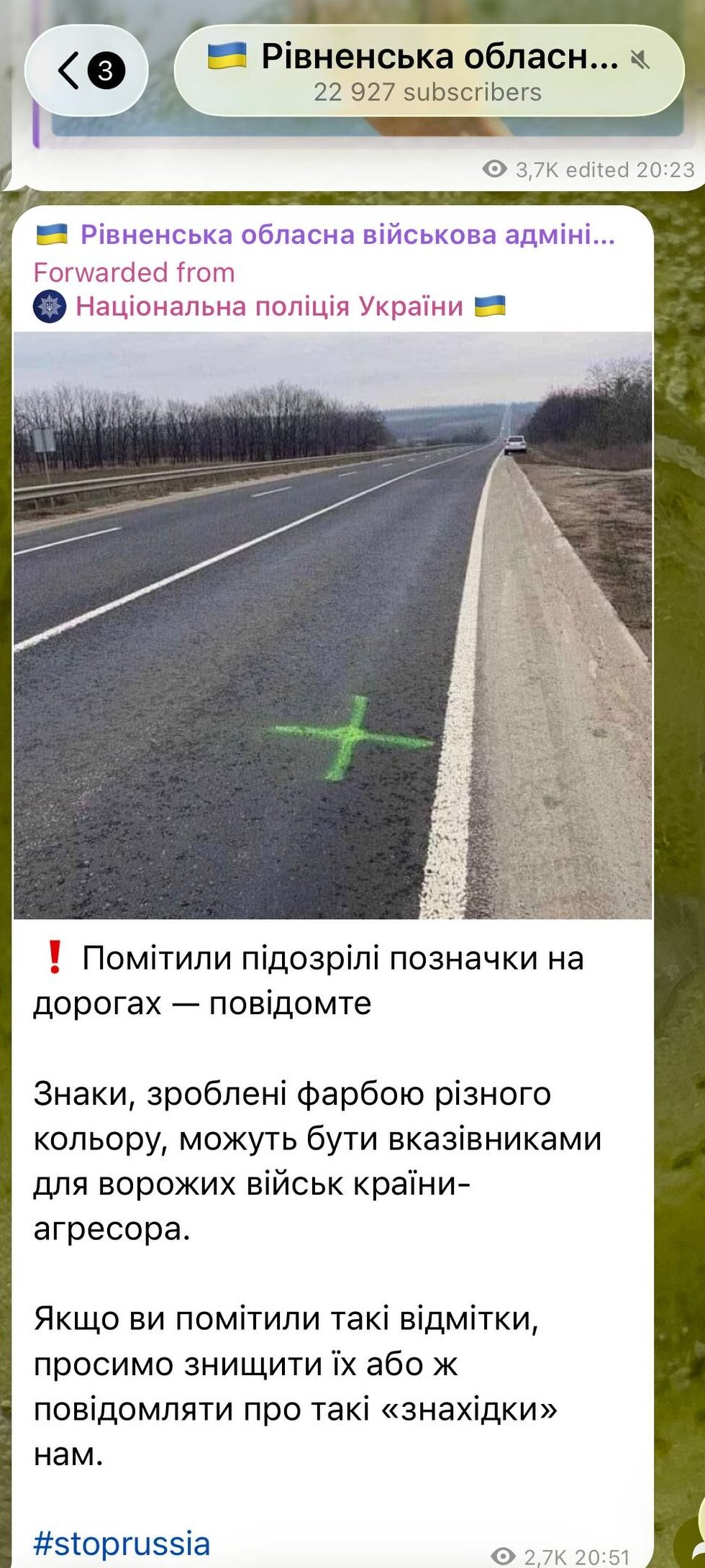
It’s probably easy to laugh off now, but these signs, crosshairs and arrows were popping up everywhere. People noticed them wherever they went. That meant saboteurs and pro-russians must have been everywhere. Maybe even your own neighbour might be one.
People were eager to help the war effort. They called the police about every marking they noticed, and some even attempted citizen’s arrests on potential saboteurs. The pictures above were posted by a police officer with the caption to urgently cover up these signs and alert the authorities.
The reality, however, was considerably less clear-cut. A lot of these supposed crosshairs were simply road markings, construction markings or slightly tactical-looking graffiti. Some may have been deliberately placed. Others may have been vandalism, possibly by people looking to cause trouble or simply to profit from the panic. A number of the photographs circulating at the time were even taken in moscow.
I strongly doubt any russian agents dirtied their hands with graffiti. My view of russian technology is pretty dim; however, I strongly doubt a missile that just flew a thousand kilometres needed a spray-painted crosshair to hit its target. Nor do I think russian forces were quite so optimistic that they expected to arrive in western Ukraine within days, but would somehow need spray-painted markings to find their way.
So what was the purpose of all this?
There is a quote from a particularly nasty gremlin that I will not credit which gets to the point:
“Yes, we are the ones bringing chaos to your rear… We came up with red tags, we paralysed police, we crashed your reporting bots and ‘mined’ everything in Kyiv. Every cop distracted is minus one gun. Every SBU officer hunting ‘saboteurs’ is minus one gun”
I cannot independently verify the claim behind that quote, and I don’t think it is necessary to do so for the broader lesson to matter.
What did the panic achieve? Emergency services were flooded with reports from well-meaning citizens. Checkpoints had to deal with people looking for supposed “taggers”. Paranoia spread through communities, and people who were simply trying to help sometimes created additional work for police, soldiers and emergency services.
It is not impossible that genuine saboteurs were concealed by the wave of paranoia surrounding them. Were the people behind the markings successful? Perhaps not in the way some imagined. But they demonstrated something important:
//They weaponised the vigilance of well-meaning citizens to create chaos.
What can we learn from it?
The Urgency Trap: In a crisis, your natural instinct is to share information immediately to protect loved ones. PSYOPs can exploit exactly that instinct.
Validation Loops: Rumours spread quickly, especially when local authorities or police accidentally amplify an unverified threat. A warning can create more reports, which create more warnings, which then make the original rumour appear even more credible.
Algorithms favour panic: Social media platforms reward engagement, and high-emotion content is often more engaging than calm analysis. A frightening rumour can therefore travel much faster than a boring correction.
Fakes are becoming harder to identify: Whether it is AI-generated material, an old photograph presented as new, or an image taken in another country, the context surrounding a piece of information can be manipulated even when the image itself is genuine.
The opening days of the war; an interview
That panic did not exist in isolation. It was part of a much larger information environment in which people were trying to make sense of rapidly changing events while dealing with a very real threat to their lives and communities.
Especially in the first hours and days of the invasion of Ukraine, anxiety swept the nation. The worst had come to pass and a full-scale invasion was underway. The following is a firsthand account:
Q: How did you first hear that the invasion had started?
A: I saw a message from a friend at 6:47 AM saying simply, “It started.” Seconds later, I heard my mom in the other room saying the war had begun.
I immediately started scrolling through the news. There was already such an overwhelming flood of information that it was nearly impossible to comprehend everything, let alone process that it was actually happening.
Q: Did you have any kind of plan? What were your immediate next steps?
A: I didn’t really have a plan. I was one of the many people who had believed the war wouldn’t actually start, that it was all just posturing to scare us.
After reading the news and talking with friends for an hour or more, I packed my essential documents, some clothes, and emergency cash in case we needed to move fast.
Then I went to the store to buy water and basic groceries, returned home, and tried to work as usual while checking news channels continuously.
We didn’t have a reliable vehicle ready for a long trip at that moment, so our options were limited. Our strategy was mostly to sit, monitor the news, and weigh possible scenarios: whether to head to a family village, try to find a house further west, or attempt to go abroad. But going abroad meant leaving family members behind, which made the decision even harder.
The first day felt completely surreal. There were no direct explosions or air raid sirens in our area yet, so it felt like living through a bad dream. Everyone kept hoping it would end in a day or two.
Q: How did authorities communicate, and what were their instructions?
A: The President made an official address explaining the situation, followed by local announcements confirming that schools were closed, listing operational medical facilities, and providing shelter addresses, though many turned out to be locked when people actually tried to access them.
Authorities asked citizens to yield to emergency and police vehicles at gas stations without queuing, and urged people to donate blood. Later, our regional military administration published lists of verified channels to follow and warned against specific sources spreading active misinformation.
During that first day, they also shared instructions on how to take cover during different types of shelling. However, the national police also posted warnings about potential enemy markings, asking the public to report and destroy any symbols they found, which, looking back, inadvertently fed into the initial wave of public panic.
Q: Which everyday systems began to fail first, and how did the public react?
A: Supermarkets, gas stations, and ATMs immediately saw massive queues. Gas ran out very quickly because people had been waiting in line since 5:00 AM, and cash dried up just as fast.
On the second day, the government imposed strict limits on how much fuel you could buy per vehicle and how much cash you could withdraw from an ATM. Supermarkets quickly adapted by allowing people to cash out small amounts directly at the register.
Mobile signal was spotty and dropped in waves. Military checkpoints were established almost overnight on highways and main city entrances.
By the afternoon, the streets were completely empty; people were terrified to go outside. Word quickly spread through neighborhood chats that we should keep all lights off at night and block windows to prevent giving incoming missiles a visual signal.
The streetlights were turned off completely. The city was plunged into total darkness—it was similar to the blackout power outages we experienced later in the war, but far more terrifying because of how eerily quiet it was outside.
I remember standing on our balcony with my mom one evening and spotting a low, blinking red light hovering silently in the sky. It wasn’t moving at all, and we assumed it was a drone monitoring street movements.
Q: In a single word, how would you describe the news cycle during those first days?
A: Overwhelming.
Q: What disinformation, rumour or story affected you or your city the most?
A: There was an endless amount of disinformation and rumour. People were talking non-stop, and unverified reports travelled at lightning speed.
It’s hard to pick just one, but the painted symbols caused the most immediate disruption. The drama in our apartment owners’ group chat was unbelievable. People were aggressively arguing that the markings had to be scrubbed off instantly or our building would be targeted, while others insisted they were just old construction marks.
In addition, warnings circulated that we should report anyone wearing dark clothes or balaclavas, as they might be infiltrators or collaborators.
There was also a constant wave of rumours about localised gunfire, strikes, or major fires across the city. People claimed with absolute certainty that our city was going to be heavily bombed on the second night, or that an immediate secondary invasion force was going to wipe out the region in a day.
People didn’t share these as guesses. They framed them as absolute facts from “reliable sources”, 90% of which turned out to be completely false.
Q: Looking back, is there anything you wish you had done differently?
A: I wish I had packed an emergency bag earlier and kept more stored water and cash in the house.
Honestly, I also wish my family and I had been able to relocate to a safer area together before it all started. Not necessarily because our city was as dangerous as Kyiv or the front-line cities at the time, but because being separated during a crisis creates an incredible emotional strain when you’re used to facing everything together.
Questions to ask yourself before posting:
1. Who is telling me this?
Do I know the source?
2. How do they know?
Is this firsthand information, or “a friend of a friend”?
3. Why am I being told this now?
Does the message create urgency or fear?
4. Can I independently verify it?
Can I find confirmation from an official source or multiple reliable sources? Be careful here: multiple articles are not necessarily multiple sources. Several outlets can all be repeating the same original, unreliable post.
5. Who could be harmed if I’m wrong?
Could sharing this expose people, movements, locations or operations?
6. Do I actually need to share it?
This one is surprisingly important.
That last question deserves more attention than it usually gets – the information doesn’t have to be false for sharing it to create a problem.
Digital discipline in practice
- Evaluate the impact of your presence: Consider a simple example: you go to the supermarket and notice they are out of toilet paper. Posting about this factual occurrence online can cause more damage than benefit by triggering panic buying. The actual consumption of basic goods may not have changed dramatically; the panic itself can create the shortage.
- Speed is not the priority: An unverified rumour can cause immediate harm, even if it eventually turns out to be true. The priority should be reliability, not being the first person to share something.
- Protect sensitive operational data: Loose lips sink ships. Seeing military equipment or air defence systems on the move can be exciting, and the first instinct might be to take a photo and share it with a patriotic caption. Doing this can accidentally expose useful information about locations, movements, timing and capabilities. If you feel you must post, remove identifying details and avoid posting information while it could still be operationally relevant.
- Help those around you stay disciplined: Information hygiene is a shared effort. Similarly to having to explain to your uncle that there is a difference between a Facebook comment and a private message, or telling him the funny dancing dog is in fact AI, it is your duty and your responsibility to gently correct family and friends when they share unverified warnings in group chats.
- Never forward first; verify first: If a message arrives in a group chat with an urgent prompt like “Forward this to everyone to keep your loved ones safe!”, treat it as suspicious until you can establish where it came from and whether the threat is real.
- Contain internal venting: Private frustrations belong in private channels. Public venting about operational friction or supply delays can become raw material for foreign propaganda. That doesn’t mean criticism should never be voiced; it means understanding the difference between legitimate criticism and broadcasting information that can have consequences beyond your own frustration.
- Ask the core question: “Who Benefits?” This is the most critical question you can ask yourself before hitting share. Even for completely true, innocent posts, ask: Does sharing this lower public morale, create physical rushes on stores, distract emergency services, or expose information that someone else can use? If the answer is yes, pause and contain it.
You don’t need to become an intelligence analyst. You don’t need to understand Russian doctrine. And you certainly don’t need to stop using social media.
You just need to slow down.
Before you forward something, ask whether it’s true. Ask where it came from. Ask how they know. Ask who benefits from you believing it. And, perhaps most importantly, ask who might be harmed if you’re wrong.
We often imagine information warfare as something conducted by governments, intelligence services and professional propagandists. In reality, the battlefield is also made up of ordinary people sitting at home with a phone in their hand. We can’t control everything that appears online. We won’t be able to identify every fake image, every manipulated video, or every coordinated information operation.
We don’t need to.
//We can control what we add to it.
In an information war, pressing “share” is still an action.
Treat it like one.
Keep this in the back of your head, not only for what you and your friends and family put out, but also for the content you consume. The information battlefield is a tough one. With minimal moderation and varying interests at play, it’s an uphill fight.
Hopefully this article helps you look at the information around you a little differently. Not everything is propaganda. Not everything is true. And not everything that is true needs to be shared.
There Is More to the Information Battlefield
The examples above are only one part of a much larger problem.
Information operations do not only try to make us believe individual falsehoods. They can be used to influence elections, undermine trust in institutions, exploit political divisions, target specific communities, and shape how entire societies understand events happening around them.
And as these operations become more sophisticated, increasingly using coordinated networks, artificial intelligence, and carefully tailored messaging the battlefield becomes harder to see.
That deserves its own discussion.
So if you have any questions or requests for our next article on this subject, shoot us a message.
-Pete
References & Further Reading
- European External Action Service (EEAS) —
Ukraine: A Persistent Target of Russian Foreign Information Manipulation and Interference (2026).
Read the report - European External Action Service (EEAS) —
Inside the Infrastructure of Foreign Information Manipulation and Interference (FIMI) Operations (2025).
Read the article - Radio Free Europe/Radio Liberty (RFE/RL) —
Crosses For Chaos: How Russian Ultranationalists Used ‘Missile Markers’ To Sow Panic In Ukraine As Russia Invaded (2024).
Read the investigation - Cybersecurity and Infrastructure Security Agency (CISA) —
Think Before You Link: Disinformation Stops With You.
Read the guide - RAND Corporation —
Truth Decay: An Initial Exploration of the Diminishing Role of Facts and Analysis in American Public Life.
Read the report - Ukrainska Pravda —
Modern military equipment does not use targeting by markings on poles and roofs (February 27, 2022).
Read the article
-
 Malva Ammunition IFAK Organizer580,00 ₴
 -
Malva Ammunition Standard IFAK1 200,00 ₴
-
Malva Ammunition Recon Bag2 000,00 ₴
-
Malva ”Mugger” Bag2 000,00 ₴